CCTV & Video Surveillance Installation Luxembourg
TSECUR designs and installs IP video surveillance systems for businesses, shops, warehouses, offices and homes in Luxembourg. The aim is not to install as many cameras as possible, but to cover the right areas, obtain usable images and provide simple, secure access.
Risk assessment and camera placement
Before installation, TSECUR reviews entrances, sensitive areas, lighting constraints, distances and identification needs. This assessment determines the number of cameras, viewing angles, resolution, lens type, night illumination and required recording time.

IP cameras, PoE and local recording
An IP architecture uses high-definition cameras connected to the network. Power over Ethernet can carry data and power through one cable. Footage is stored on a suitable recorder with capacity sized for the number of cameras, resolution and desired retention period.
Secure access from a smartphone or computer
When required, authorised users can view live or recorded video remotely. TSECUR configures accounts, access rights and security settings. Default passwords are replaced and access is limited to people who genuinely need it.
Video analytics and artificial intelligence
Recent cameras can classify certain movements, filter unnecessary triggers and speed up event searches. Depending on the model, analytics may identify people or vehicles, monitor a virtual line or report entry into a protected area. These functions reduce alert noise, but performance depends on placement, lighting and configuration. TSECUR sets the rules and tests them on site.
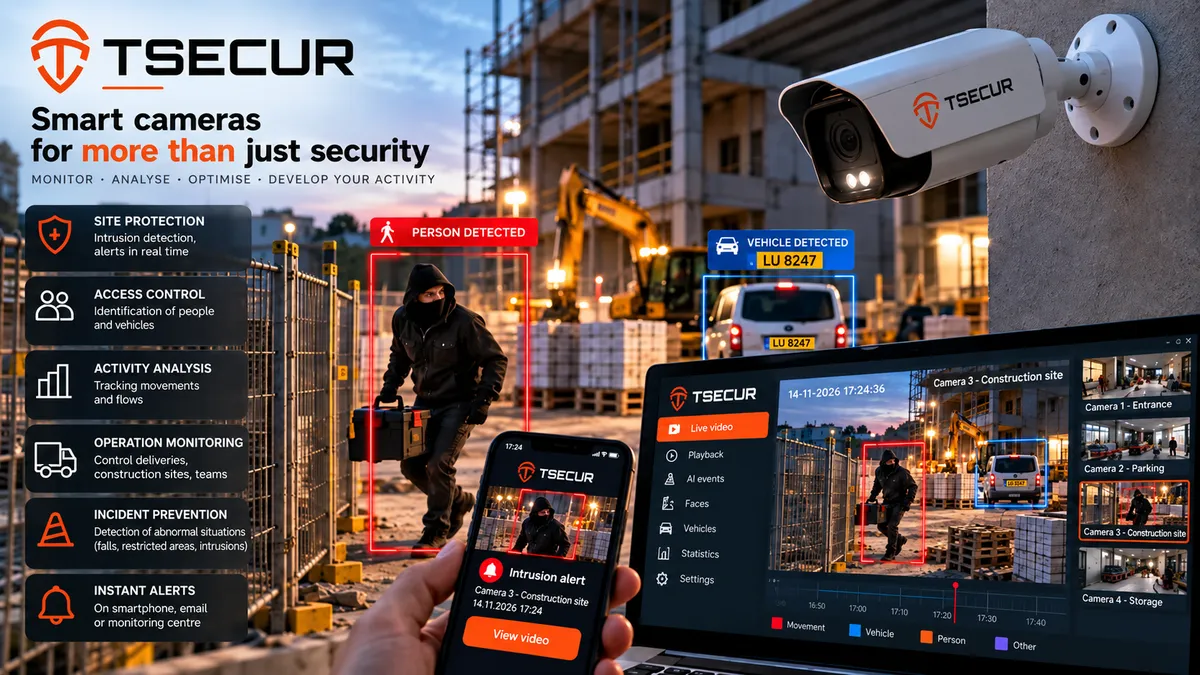
Video surveillance for businesses and homes
For a shop or warehouse, the system can protect entrances, loading areas, stock rooms and circulation zones. At home, it can cover the entrance, garage or outside perimeter. Every installation must respect privacy, avoid irrelevant areas and include the required information notices.
Request a video surveillance assessment
Describe the premises, areas to protect, operating hours, required image quality and remote-access needs. TSECUR will prepare a proposal covering equipment, installation, configuration and user handover.
Cybersecurity and account protection
A connected CCTV system must be protected like any other networked equipment. Default passwords should be replaced, administrator accounts restricted, firmware maintained and remote access configured through the manufacturer’s supported secure method. Separate user accounts improve traceability. Cameras and recorders should not be exposed directly to the internet without an assessed security design.
Recording capacity and image retention
Storage is calculated from camera count, resolution, frame rate, compression, scene activity and retention period. Higher resolution does not automatically produce better evidence if the lens, lighting or camera position is unsuitable. TSECUR balances identification needs, bandwidth and disk capacity, then checks recorded images in realistic daytime and night-time conditions.
Maintenance and system handover
The handover should include user accounts, viewing and export instructions, camera names, retention settings and a record of the installed equipment. Periodic maintenance checks image quality, time synchronisation, storage health, camera cleanliness, network communication and notifications. A system that records a blurred lens or has a failed disk provides only an illusion of protection.
Frequently Asked Questions
How many cameras should be installed?
The number depends on entrances, blind spots and identification goals. A plan-based or on-site survey avoids unnecessary cameras and uncovered areas.
How long should recordings be retained?
It depends on the need, legal framework and storage capacity. Storage is sized according to camera count, resolution, bitrate and selected retention period.
Can I view the cameras on my phone?
Yes, when the installation and security policy allow it. Access must be protected and restricted to authorised users.
Does AI eliminate every false alert?
No. It can reduce many unnecessary alerts, but performance depends on the scene, weather, lighting and rule configuration.
Which rules apply in Luxembourg?
The system must comply with data-protection and privacy requirements. Purpose, access, information notices and retention periods should be defined for the specific context.